
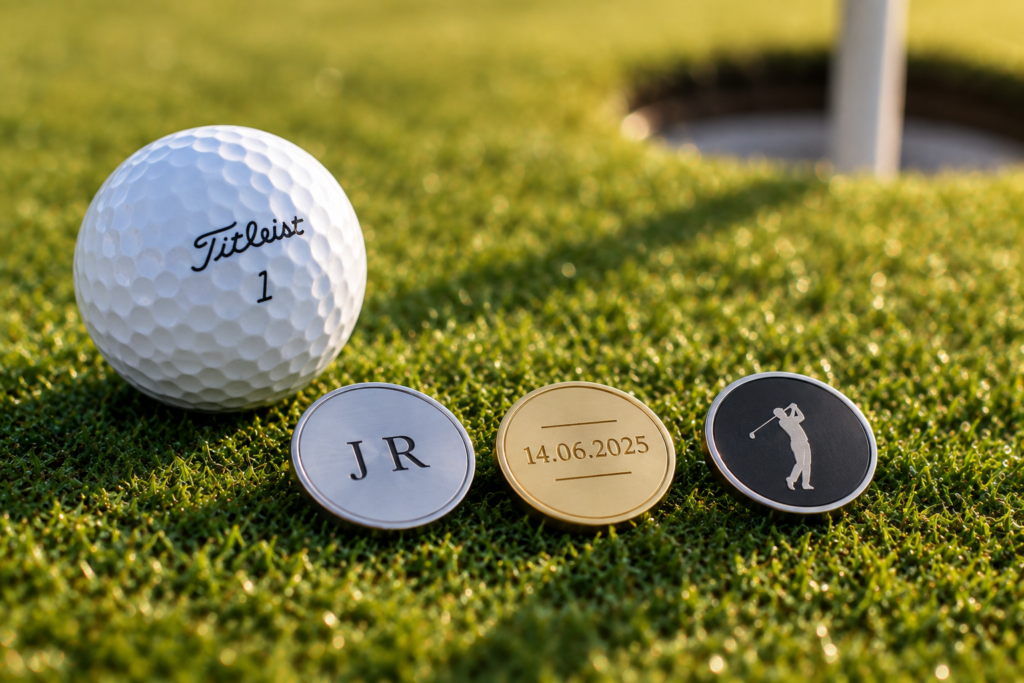
Golf is a game of fine margins. A single putt can decide a match, a well-read green can save a round, and the smallest details often make the biggest difference. Yet among all the equipment a golfer carries — drivers, irons, wedges, putters, gloves, tees, and towels — one of the smallest items is also one of the most personal. The humble golf ball marker may be only a few centimetres across, but it sits at the heart of the game’s etiquette, and when it is personalised, it becomes something far more than a practical tool. It becomes a signature, a keepsake, and a quiet statement of personality.
Personalised golf ball markers are one of those small details that add real character to a golfer’s game. They are functional, affordable, and endlessly customisable, yet many golfers never give them a second thought. This article takes a closer look at what golf ball markers are, why personalisation matters, how to choose the right one, and how a tiny disc of metal or plastic can become one of the most meaningful items in your bag.
What Is a Golf Ball Marker?
A golf ball marker is a small object used to mark the position of a golf ball on the green. When a golfer’s ball is on the putting surface and another player needs to putt, the first player marks the ball’s position, lifts the ball, and then replaces it once the other player has putted. This is a basic requirement of golf etiquette and is governed by the rules of the game.
Traditionally, markers were simple coins — and many golfers still use a coin today. But over time, dedicated ball markers have become increasingly popular. They are typically flat, circular, and made from metal, plastic, or a combination of materials. They are designed to sit flat on the green without interfering with another player’s line, and they are small enough to fit comfortably in a pocket or attach to a hat clip.
The humble marker has evolved into something of a collectible. Golf clubs, tournaments, and famous courses often produce their own branded markers, and many golfers build up a small collection over the years. But beyond the branded and the collectible, there is a growing market for personalised markers — items that carry a name, initials, date, or design that is unique to the player.
Why Personalisation Matters
At first glance, a ball marker might seem too small to bother personalising. But there are several reasons why personalisation matters more than you might think.
First, it makes the marker easier to identify. Golf bags, pockets, and golf carts are full of small items, and markers are easy to lose or confuse with someone else’s. A personalised marker is instantly recognisable. If you leave it on the green or drop it in the clubhouse, there is a much better chance it will find its way back to you.
Second, it adds a personal touch to a game that is often played in a group. Golf is a social sport, and playing partners notice the small things. A marker with your initials, your home club’s crest, or a design that means something to you can become a conversation starter. It is a subtle way of expressing who you are without saying a word.
Third, it makes a thoughtful gift. Personalised golf ball markers are one of the most popular gifts for golfers, precisely because they are small, useful, and personal. They work for birthdays, Christmas, Father’s Day, retirement, or as a memento of a special round or a trip to a famous course.
Fourth, it can carry sentimental value. A marker engraved with a date, a score, or the name of a course can become a keepsake. Many golfers keep a marker from a memorable round — a first hole-in-one, a career-best score, or a round played with a close friend — and carry it with them for years.
Finally, personalisation is simply enjoyable. Choosing a design, a colour, a font, and a finish is a small creative act. It turns a functional item into something that reflects your taste and personality.
Types of Personalised Golf Ball Markers
There is no single type of personalised marker. The market offers a wide range of options, each with its own advantages and aesthetic.
Metal Markers
Metal markers are the most traditional and the most durable. They are typically made from stainless steel, brass, copper, or aluminium, and they can be engraved, stamped, or laser-etched with a name, initials, logo, or design. Metal markers have a satisfying weight and a premium feel, and they tend to age well. Many golfers prefer them because they sit flat on the green and are easy to pick up.
Plastic and Resin Markers
Plastic and resin markers are lightweight, affordable, and available in a huge range of colours and shapes. They can be customised with printed designs, embedded objects, or coloured inserts. While they may not have the same premium feel as metal, they are a great option for golfers who want something colourful, fun, or inexpensive.
Wooden Markers
Wooden markers offer a natural, rustic aesthetic. They are often made from hardwoods such as oak, walnut, or maple, and they can be engraved with names or designs. They are lightweight and warm to the touch, and they appeal to golfers who prefer a more organic look.
Enamel and Inlaid Markers
Enamel markers combine metal with coloured enamel fills, allowing for detailed and vibrant designs. They are popular for club crests, logos, and colourful patterns. The enamel finish is durable and resistant to wear, making these markers a good choice for regular use.
Combination and Multi-Tool Markers
Some markers combine the marker with other useful features, such as a divot tool, a bottle opener, or a magnetic hat clip. These combination tools are practical and popular, and they can also be personalised. A marker that doubles as a divot repair tool is particularly useful, as it means one less item to carry.
Magnetic Hat Clips
Many markers come with a magnetic hat clip, which allows the marker to be attached to the brim of a cap or the edge of a pocket. This is a convenient way to keep the marker close at hand, and it also makes the marker more visible. Personalised hat clips are a popular choice because they combine practicality with a personal touch.
Materials and Quality: What to Look For
If you are investing in a personalised marker, it is worth paying attention to the quality of the materials and the craftsmanship.
Metal thickness and finish. A good metal marker should be thick enough to feel solid but thin enough to sit flat on the green. Look for a smooth, even finish without sharp edges or rough spots. Stainless steel is a reliable choice because it resists rust and wear. Brass and copper develop a natural patina over time, which some golfers love and others prefer to avoid.
Engraving quality. The quality of the engraving or etching matters, especially if the marker includes fine detail. Laser engraving tends to be precise and durable, while hand-stamping can have a more artisanal, slightly irregular look. If the design includes text, check that the font is clear and legible at a small size.
Weight and feel. A marker should feel comfortable in the hand and easy to place and pick up. Very light markers can feel flimsy, while very heavy ones may be awkward to carry. A marker that is too thick may also interfere with another player’s putting line, so keep the profile low.
Durability. If the marker will be used regularly, choose a material that will withstand being dropped, sat on, and rattled around in a golf bag. Metal and enamel markers tend to be the most durable, while plastic and wooden markers may show wear more quickly.
Safety and smoothness. A marker should have no sharp edges or protruding parts that could damage the green or scratch a golf ball. Check the edges and the underside before use.
Design Ideas for Personalised Markers
One of the joys of a personalised marker is the freedom to choose a design. Here are some popular ideas to consider.
Initials or a full name. Simple, classic, and easy to read. Initials are a popular choice because they are compact and elegant, while a full name can be more personal.
A favourite number. Many golfers have a lucky number, a favourite player’s number, or a number that means something to them. A number marker is simple and distinctive.
A date. A wedding date, a birthday, or the date of a memorable round can be engraved on a marker. This turns it into a keepsake rather than just a tool.
A club crest or logo. If you belong to a golf club, a marker bearing the club’s crest is a classic choice. It shows affiliation and pride.
A symbol or icon. A shamrock, a star, a tree, a mountain, a wave, or an animal can all be used as a design. Symbols allow for personal expression without using text.
A motivational word or phrase. Short words such as “focus,” “breathe,” or “trust” can serve as a gentle reminder on the course. Keep the text short so it remains legible.
A map or location. A marker shaped like a country, state, or city can celebrate a home region or a favourite travel destination.
A monogram or family crest. For golfers with a family crest or monogram, a marker can be a subtle way to display heritage.
A photo or image. Some custom markers allow for printed images, which can include a photo, a logo, or a piece of artwork. These are especially popular as gifts.
A themed design. Golf-themed designs such as a flag, a hole, a tee, or a golf ball are always appropriate and easy to recognise.
Personalised Markers as Gifts
Personalised golf ball markers are one of the most reliable gifts for golfers. They are small enough to be affordable, useful enough to be appreciated, and personal enough to feel thoughtful.
For a beginner. A marker with their initials and a simple design is a practical and encouraging gift. It says, “Welcome to the game.”
For a regular playing partner. A marker engraved with a shared joke, a nickname, or the name of a course you both love can be a meaningful gesture.
For a club member. A marker bearing the club crest, paired with a divot tool or a hat clip, makes a smart and useful gift.
For a special occasion. A marker engraved with a date — a birthday, an anniversary, a retirement — becomes a memento of the occasion.
For a milestone round. If a friend has just achieved a personal best, a first win, or a hole-in-one, a personalised marker commemorating the achievement is a wonderful way to mark the moment.
For a holiday or trip. A marker from a famous course or a destination visited on a golf trip can become a lasting reminder of the experience.
When choosing a gift, consider the recipient’s style. A minimalist golfer may prefer a simple metal marker with initials, while a more flamboyant player may enjoy a colourful enamel design. If you are unsure, a classic metal marker with a clean engraving is a safe and elegant choice.
How to Choose the Right Marker for You
With so many options available, choosing a marker can feel overwhelming. Here is a simple framework to help you decide.
Start with function. How will you use the marker? If you play regularly, durability and ease of use should come first. If it is primarily a keepsake, design and sentiment may matter more.
Consider your carry style. Do you prefer a marker that sits in your pocket, attaches to a hat clip, or combines with a divot tool? Your carry style will influence the size, weight, and shape you choose.
Think about visibility. A marker that is easy to see on the green is less likely to be left behind. Bright colours, reflective finishes, and distinctive shapes can help.
Match your personality. A marker is a small expression of who you are. Choose a design that feels right to you, whether that is understated and classic or bold and colourful.
Check the size. Markers vary in diameter and thickness. A marker that is too large may be distracting, while one that is too small may be fiddly to handle. If possible, look at the dimensions before buying.
Set a budget. Personalised markers range from inexpensive plastic options to premium engraved metal pieces. Decide what you are comfortable spending and choose accordingly. In most cases, a modest budget is enough to get a high-quality, personalised marker.
Read reviews. If you are buying online, reviews can tell you a lot about the quality of the engraving, the durability of the material, and the accuracy of the design. Pay attention to comments about size, weight, and finish.
Caring for Your Personalised Marker
A personalised marker is a small investment, and a little care will keep it looking good for years.
Keep it clean. Wipe the marker with a soft cloth after use to remove dirt, grass, and moisture. For metal markers, a mild metal polish can restore shine, though some golfers prefer to let a natural patina develop.
Store it safely. A small pouch or a dedicated pocket in your golf bag will protect the marker from scratches and loss. If the marker has a hat clip, store it attached to a cap or in a safe compartment.
Check for wear. Inspect the marker regularly for loose parts, worn engraving, or sharp edges. If the marker is damaged, replace it to avoid any risk to the green or to other players.
Avoid extreme conditions. Prolonged exposure to moisture can cause some metals to rust or tarnish. If your marker gets wet, dry it thoroughly before storing it.
Keep it secure. Markers are easy to lose. A magnetic hat clip or a small lanyard can help keep it attached to you or your bag.
Etiquette and the Marker
Using a ball marker correctly is part of golf etiquette. Here are a few reminders.
Mark your ball before lifting it. Place the marker directly behind the ball, then lift the ball. When it is your turn to putt, replace the ball in front of the marker, then remove the marker.
Do not stand on another player’s line. When marking and replacing your ball, be mindful of where you stand. Avoid walking on or near another player’s putting line.
Keep the marker flat. A marker that sits proud of the green can deflect a putt. Choose a low-profile marker and press it gently into the surface.
Do not use a marker that damages the green. Sharp edges, protruding parts, or heavy objects can damage the putting surface. Always use a marker designed for the purpose.
Be ready to mark. In ready golf, players are encouraged to mark and play promptly. Having your marker easily accessible — for example, on a hat clip — helps keep the pace of play moving.
The Collectible Appeal
Beyond personal use, golf ball markers have become a popular collectible. Golfers often pick up markers from famous courses, tournaments, and resorts, and some build impressive collections over time. Personalised markers sit alongside these collectibles as items with both practical and sentimental value.
For some golfers, a marker collection becomes a record of their golfing life — a tour of the courses they have played, the trips they have taken, and the people they have played with. A personalised marker can be the centrepiece of that collection, representing the player themselves rather than a place or event.
Sustainability and Craftsmanship
As with many consumer products, there is a growing interest in sustainable and ethically made golf accessories. Some makers use recycled metals, responsibly sourced wood, or eco-friendly packaging. Others focus on small-batch craftsmanship, hand-finishing each marker rather than mass-producing them.
If sustainability matters to you, look for markers made from recycled or recyclable materials, and choose makers who are transparent about their sourcing and production. A well-made marker that lasts for years is itself a sustainable choice, since it replaces a series of cheap, disposable items.
A Small Detail with Big Impact
It is easy to overlook the ball marker. It is small, inexpensive, and easily lost. But it is also one of the few pieces of golf equipment that is truly personal. A driver is chosen for distance, an iron for forgiveness, a putter for feel — but a marker is chosen for identity.
A personalised golf ball marker says something about the player who carries it. It might say, “This is my club.” It might say, “This is my name.” It might say, “This round mattered.” Or it might simply say, “I like this design.” Whatever the message, it is a message chosen by the golfer, and that is what makes it meaningful.
In a game built on tradition, small details carry weight. The marker that sits on the green, the divot tool that repairs the pitch mark, the hat clip that keeps everything together — these are the quiet accessories that shape the experience of a round. Personalising them is a way of making the game your own.
Final Thoughts
Personalised golf ball markers are a small detail, but they add big personality to your game. They are practical, affordable, and endlessly customisable, and they make excellent gifts for golfers of all levels.
When choosing a marker, think about function, materials, design, and carry style. Consider the quality of the engraving and the durability of the material. Decide what message or image you want the marker to carry, and choose a design that reflects your personality and your relationship with the game.
Whether you prefer a classic engraved metal disc, a colourful enamel design, a wooden keepsake, or a multi-tool combination, a personalised marker is a small investment that pays off every time you step onto the green. It keeps your ball safe, your game organised, and your personality on display.
Personalised golf ball markers: small details, big personality. Sometimes the smallest items in the bag are the ones that say the most.
Lionel Messi picked the perfect moment to bring up a milestone. Eight minutes after Algeria thought they’d taken a shock lead, Messi rifled in the only goal of the game to send Argentina top of Group J and keep their World Cup title defense firmly on track.
The 1-0 win at Kansas City’s Arrowhead Stadium wasn’t the routine stroll some predicted. Algeria pushed Argentina harder than the scoreline suggests, and for a few first-half minutes it genuinely looked like the reigning champions might be in trouble.
How the Goal Went In
The opening exchanges were chaotic by World Cup standards — two goals were scored and ruled out inside the first ten minutes before either side actually got one to stand.
Messi thought he’d opened the scoring in the fifth minute, slotting the ball home only for the offside flag to go up. Algeria responded almost immediately: winger Fares Chaibi finished smartly from a tight angle in the eighth minute, only to suffer the same fate when the assistant referee ruled him narrowly offside as well.
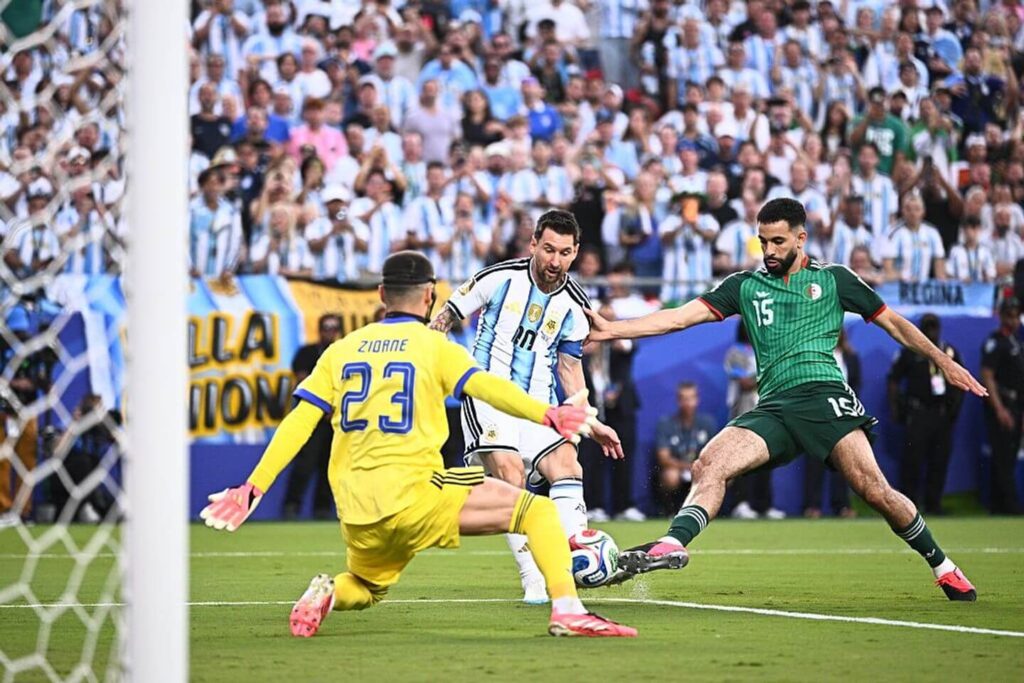
The breakthrough finally arrived in the 17th minute. Rodrigo De Paul, so often described as Messi’s on-field minder, turned provider instead, splitting Algeria’s defense with a pass that put his captain through on goal. Messi advanced to around 25 yards out and drilled a shot that goalkeeper Luca Zidane got both hands to but couldn’t keep out. Argentina led, and they wouldn’t relinquish it.
A Landmark Night for Messi
The goal carried extra significance beyond the three points. It was Messi’s 200th appearance for the Argentine national team, his 118th international goal, and his 14th at a World Cup finals — pulling him level with Gerd Müller and Kylian Mbappé on the all-time World Cup scoring list, behind only Miroslav Klose and Ronaldo.
Messi also became the first male player to appear at six different World Cups, a run stretching back to Germany 2006. He turns 39 just before Argentina’s final group match against Jordan, and questions about how much he still has left have followed him into this tournament. On this evidence, at least for one night in Kansas City, he answered them in the most Messi way possible.
Algeria Made Argentina Work For It
Don’t mistake a 1-0 scoreline for a one-sided match. Algeria, back at the World Cup for the first time since 2014, more than held their own for long spells, particularly before the opening goal. Chaibi was a persistent threat down the right and had Argentina’s defense scrambling more than once after the break, while veteran winger Riyad Mahrez and the in-form Ibrahim Maza gave Algeria’s attack a cutting edge that’s been missing from previous tournament campaigns.
By the numbers, the gap was tighter than a 1-0 final score implies:
| Stat | Argentina | Algeria |
|---|---|---|
| Shots | 3 | 2 |
| Shots on target | 1 | 0 |
| Possession | 55.2% | 44.8% |
| Corners | 2 | 2 |
| Fouls | 7 | 2 |
Once Argentina settled into their rhythm, though, the game tilted decisively their way. Manager Lionel Scaloni’s side controlled the ball through midfield and forced Algeria into a deeper, more reactive shape for most of the second half.
Catching up on Group J? Bookmark our [World Cup 2026 hub] for live scores, lineups, and recaps from every match.
Lineups and Team News
Scaloni named a 4-4-2 with Emiliano Martínez in goal behind a back line of Facundo Medina, Lisandro Martínez, Cristian Romero, and Gonzalo Montiel. Thiago Almada and Rodrigo De Paul flanked a central midfield pair of Enzo Fernández and Alexis Mac Allister, with Lautaro Martínez partnering Messi up front. Montiel, who missed time through injury heading into the tournament, was passed fit enough to start.
Algeria lined up in a 4-3-3 built to spring Chaibi and Mahrez on the counter, though it was Argentina’s central control that ultimately decided the game.
What’s Next in Group J
The win puts Argentina top of Group J after matchday one, with Austria and Jordan completing the group. Algeria, despite the defeat, showed enough to suggest they’ll be competitive in their remaining fixtures as they chase a first World Cup knockout-stage appearance since reaching the round of 16 in 2014.
For Argentina, the bigger picture remains the same one that’s followed them since they lifted the trophy in Qatar: no nation has defended the World Cup since Brazil in 1962. One group game down, Messi and company are exactly where they need to be to chase that history.
Want live updates the next time Argentina, Messi, or Group J are in action? [Subscribe to our World Cup newsletter] for recaps delivered straight to your inbox.
FIFA World Cup 2026 | Group H | SoFi Stadium, Los Angeles | June 16, 2026
New Zealand’s Elijah Just. Remember that name.
The Motherwell midfielder — playing his club football in the Scottish Premiership — walked into SoFi Stadium in Los Angeles on Tuesday and scored one of the most memorable goals of the 2026 World Cup so far. New Zealand led Iran 1–0. The crowd inside SoFi was deafening — almost entirely pro-Iran. And yet the All Whites were winning.
Then Ramin Rezaeian equalised in the 32nd minute, and Los Angeles erupted.
At the 35-minute mark: Iran 1–1 New Zealand — and this match is far from over.
The Goal That Started It All — Elijah Just, 7 Minutes
Nobody gave New Zealand a chance tonight.
Iran, ranked far higher and containing Mehdi Taremi — one of the most dangerous strikers in European football — were heavy favourites. New Zealand were the lowest-ranked team in the entire tournament. This was supposed to be comfortable.
Then Chris Wood happened.
The Nottingham Forest striker, physicality personified, held up the ball brilliantly inside the Iran half and laid it off perfectly into the path of Elijah Just. The Motherwell man did not hesitate — a clean, crisp finish that flew past Alireza Beiranvand and gave New Zealand a stunning seventh-minute lead.
It was only New Zealand’s fifth ever goal at a World Cup finals. And it was a very good one.
Former BBC pundit Chris Sutton called Just “such an intelligent player” — adding that it was “too easy” for Chris Wood to turn and create the chance. Iran’s defence had been completely exposed.
Taremi Hits the Post — The Moment Iran Nearly Levelled
Iran did not panic. Mehdi Taremi, their captain and talisman, led a dangerous counter-attack in the 24th minute that had New Zealand retreating desperately.
Four against two. Taremi stormed forward, held the ball, and unleashed a fierce strike — only for the ball to crash off the right-hand upright. Goalkeeper Max Crocombe was beaten. The post saved New Zealand.
Former Everton midfielder Leon Osman on BBC Radio 5 Live was blunt: “It was four against two and the moment he decides to go himself, he has to score. He was very unlucky hitting the post but he had so many opportunities. They had to score there.”
Crocombe’s Horror Moment — And Iran’s Near Miss
New Zealand’s goalkeeper Max Crocombe then gave the travelling fans a heart attack.
The Millwall stopper was too relaxed on the ball as Iran’s Mohebi closed him down. The loose ball fell to Saman Ghoddos, who looped a shot towards the empty net — it went narrowly wide. Crocombe survived. Just barely.
Rezaeian Levels — Los Angeles Erupts
The equaliser came in the 32nd minute and it sparked scenes inside SoFi Stadium that went well beyond football.
Ramin Rezaeian found the net for Iran — and the Iranian fans in Los Angeles, who had packed the stadium despite the political chaos surrounding this match, went absolutely wild. These supporters had faced visa restrictions, ticket confiscations, and travel nightmares just to be here. When that goal went in, every bit of frustration poured out in celebration.
At half-time: Iran 1–1 New Zealand.
The Match Bigger Than Football
This was never just a football match.
Iran’s build-up to the 2026 World Cup has been one of the most turbulent in tournament history. The team was forced to relocate their training base from Tucson, Arizona to Tijuana, Mexico — effectively commuting across the border for every match — due to US-Iran diplomatic tensions following the countries’ recent conflict.
Captain Mehdi Taremi did not hold back before kick-off: “I have felt the tension from the first moment we arrived at this World Cup. This kind of tension, it undermines that joy and it undermines the message of Fifa and our people, which is that football brings about peace.”
Iranian protesters had vowed to disrupt the match — booing the national anthem, turning their backs, displaying pre-revolutionary flags that are currently banned by the Iranian government. Iran’s coach Amir Ghalenoei was reportedly under direct instructions from his government to halt play if those flags appeared.
The anthem was ultimately cheered inside the stadium. Football, for 90 minutes at least, took over.
New Zealand’s Diplomatic Win Off the Pitch
While Iran struggled with visa denials and a government delegation that could barely enter the country, New Zealand had the soft-power landscape of Los Angeles entirely to themselves.
New Zealand consul-general Katja Ackerley hosted a “New Zealand on the World Stage” reception at her Brentwood mansion the night before the match — wine, lamb, trade deals, and sports diplomacy. Peter Miskimmin, New Zealand’s head of sports diplomacy, put it simply: “We are building relations through sport rather than bringing up arms against one another.”
It was their first World Cup in 16 years. They came prepared for every battlefield.
What This Means for Group G
Belgium and Egypt drew 1–1 earlier on Monday. That result, combined with this one, means Group G is wide open after Matchday 1.
Group G standings after 35 minutes of Iran vs New Zealand:
| Team | P | W | D | L | GF | GA | Pts |
|---|---|---|---|---|---|---|---|
| Belgium | 1 | 0 | 1 | 0 | 1 | 1 | 1 |
| Egypt | 1 | 0 | 1 | 0 | 1 | 1 | 1 |
| Iran | 1* | — | — | — | 1 | 1 | — |
| New Zealand | 1* | — | — | — | 1 | 1 | — |
*Match in progress
A New Zealand win tonight would send them top of Group G — one of the biggest stories of the tournament. An Iran win keeps them in contention. A draw keeps everything impossibly tight.
Key Match Facts (35 Minutes)
- Venue: SoFi Stadium, Los Angeles, California
- Competition: FIFA World Cup 2026, Group G, Matchday 1
- Date: June 16, 2026
- Score at 35′: Iran 1–1 New Zealand
- New Zealand goal: Elijah Just (7′) — assist: Chris Wood
- Iran goal: Ramin Rezaeian (32′)
- Key miss: Mehdi Taremi — right post (24′)
- Iran coach: Amir Ghalenoei
- New Zealand coach: Tony Readings
Starting Line-Ups
Iran (4-3-3): Beiranvand; Khalilzadeh, Mohammadi, Yousefi, Nemati, Rezaeian; Ezatolahi, Mohebi, Ghoddos; Taremi (c), Moghanlou
New Zealand (4-4-2): Crocombe; Payne, Boxall, Cacace, Surman; Bell, Stamenic, Singh, Just, McCowatt; Wood
Ones to Watch — Second Half
Mehdi Taremi needs a goal. The Iran captain has been dangerous but wasteful — that post will haunt him if Iran drop points tonight.
Chris Wood is a nightmare for any defence. If New Zealand get the ball to him, he will cause problems. His assist for Just showed exactly what he brings.
Elijah Just — the Motherwell man has already made history. Can he do it again?
Check back on Kicks & Clips for the full-time result, second half report, and Group G standings update.
Follow all FIFA World Cup 2026 coverage on Kicks & Clips — match reports, player ratings, group standings, and analysis throughout the tournament.
Tags: Iran vs New Zealand · Iran New Zealand World Cup 2026 · Chris Wood · Elijah Just · Mehdi Taremi · Iran national football team · New Zealand national football team · Group G World Cup 2026 · SoFi Stadium Los Angeles · New Zealand football · Iran football · Iran vs New Zealand prediction · New Zealand World Cup · Iran World Cup 2026